
Checking Criminal History in Wilkes-Barre
Begin with the office that created the record. Wilkes-Barre Police handles the city report. Pennsylvania’s court portal covers the assigned Magisterial District Court and later Court of Common Pleas dockets. Luzerne County Corrections handles local custody questions, while the Pennsylvania State Police repository supplies a separate statewide history product. Asking one office for all of those records is likely to produce an incomplete response or a referral.
- Identify the event location and confirm that Wilkes-Barre Police, rather than a nearby municipal or state agency, handled it.
- Request the city incident or arrest report with the date, place, parties, and incident number when known.
- Search the Unified Judicial System portal under Magisterial District Court for the preliminary docket and bail events.
- Follow held charges into Luzerne County Common Pleas and use county Corrections for present local custody.
- Use PATCH only when the question calls for Pennsylvania State Police repository history, not the city narrative or court file.
Search each matching name with care. Compare the incident area, dates, police agency, available identity facts, OTN, and linked docket numbers. A shared name is not enough to connect a Wilkes-Barre record to a person.
Wilkes-Barre Reports Versus Court Records
Wilkes-Barre’s key record counters sit close together but do not pool their files. Police headquarters at 15 North Washington Street holds the city department’s incident and arrest material. Central Court at 77 Water Street supports preliminary criminal work from local district courts. The Clerk of Courts at 200 North River Street holds filed Common Pleas criminal cases.
That short distance can cause a costly mix-up. Police can describe what officers reported, but the department does not decide the final charge or disposition. The Clerk can provide the court file, but it does not replace the city narrative. Central Court is part of the early judicial path, not a second city police records desk. State the exact item sought, such as a releasable incident report, preliminary docket, sentencing order, or certified court copy.
Wilkes-Barre Police Department Records
The Wilkes-Barre Police Department is the starting office for a report created by its officers. A useful request names the requester and contact details, event date and time, location, parties, incident number if known, a clear record description, desired inspection or copies, delivery format, and whether certification is needed. Current copying charges, a dedicated records email, and desk hours were not stable in the official material reviewed, so confirm them with the city before filing.
Ask for an existing record. Pennsylvania’s Right-to-Know Law does not require Wilkes-Barre to create a new summary or answer a question. “The releasable incident report for the event at this place on this date” is far more precise than “tell me everything that happened.” A report may still be withheld or redacted for an active criminal investigation, victim protection, juvenile information, medical facts, confidential sources, or security concerns.
Wilkes-Barre Arrest Records Reach Central Court
After a Wilkes-Barre arrest tied to a criminal complaint, preliminary arraignment and bail occur through a Magisterial District Judge. Central Court supports this preliminary layer. The docket may then show a complaint, hearing events, bail, and whether counts were held, withdrawn, or dismissed. That first docket is not always the end of the case.
If charges are held for court, the case moves into the Court of Common Pleas. The originating district docket and OTN, or Offense Tracking Number, help connect the two stages. Court users may see a later docket beginning with the local CP-40-CR pattern. A summary matter can remain at the district level unless appealed. This path explains why a Wilkes-Barre name search must often be repeated under both court types.
Case flow: Wilkes-Barre Police › preliminary arraignment › Magisterial District Court › Central Court support › Luzerne County Court of Common Pleas.
Wilkes-Barre Arrests and Bookings
A Wilkes-Barre arrest can create several records at once. Police create the report and probable-cause material. Booking staff record intake identity, time, fingerprints, photograph, charges, property, and release or bond facts. The district court records the complaint, preliminary arraignment, bail, and hearing. PSP may later receive qualifying fingerprint-supported history data.
Charges written at arrest may change. A prosecutor can amend them, a judge can dismiss or hold counts, and a plea or trial can produce a different result. Booking data is therefore not proof of guilt. For a released person, the court docket may remain useful after a custody search no longer returns a live result. For deeper county-wide arrest routing, the Luzerne County arrest lookup explains the agency, court, corrections, and repository paths.
Wilkes-Barre Booking Records at County Corrections
Wilkes-Barre does not supply a separate long-term city jail search. City arrestees ordinarily enter Luzerne County custody. The county Correctional Facility is the official starting point, and PA SAVIN can support a name-based custody check and notices about release, transfer, or escape. A very recent booking may require a call to Corrections at 570-829-7741 because online data can lag.
PA SAVIN is a notification service, not a certified Wilkes-Barre booking sheet or a full criminal history. Ask Corrections or the proper records officer for a named booking item when a formal intake record is needed. If a person later serves a state sentence, the PA DOC Inmate/Parolee Locator becomes the better channel. City police, county custody, and state custody remain separate even when they concern one case.
Municipal Court Records in Wilkes-Barre
Pennsylvania does not use a Wilkes-Barre municipal court for full misdemeanor or felony cases. City arrests generally begin before the geographically assigned Magisterial District Judge. That court handles preliminary arraignments and hearings, summary offenses, traffic cases, and municipal-code matters. Cases held for court proceed to Luzerne County Common Pleas.
| Court structure | Assigned Magisterial District Court first, followed by Common Pleas for charges held for court. |
|---|---|
| Early case types | Preliminary criminal stages, summary offenses, traffic, and municipal-code cases. |
| Lookup channel | Free Unified Judicial System Case Search, plus the specific district office for paper records. |
| Docket contents | Complaint, arraignment, bail, preliminary hearing, charges, events, status, and disposition at that layer. |
| Later county file | Common Pleas docket and Clerk documents for a misdemeanor or felony held for court. |
Read each charge line through its disposition. A status such as disposed does not always mean convicted, and an active docket does not by itself prove present custody or an active warrant.
Searching Wilkes-Barre Court Records in UJS
The Unified Judicial System of Pennsylvania Web Portal offers participant name, case number, organization, citation number, police incident or complaint number, attorney, and some calendar-event searches. Choose Magisterial District Court and Luzerne County for a new or summary matter. Choose Court of Common Pleas and Luzerne County for a held misdemeanor or felony.
Open the full docket. Check court type, county, caption, filing date, status, arresting agency, originating docket, OTN, charges, bail, events, entries, disposition, and sentence. Then compare the early and later records. A complaint, affidavit, motion, transcript, or sentencing order may require a request to the maintaining clerk because the public portal mainly exposes case information and docket sheets.
| Search Choice | Best Use in Wilkes-Barre | Key Check |
|---|---|---|
| Participant name | Finding likely city cases without a docket number | Compare agency, dates, and identity facts. |
| Police incident or complaint number | Connecting a known city event to a court result | Confirm court type and county. |
| MDJ docket | Reviewing arraignment, bail, and preliminary events | Look for held, dismissed, or withdrawn counts. |
| CP-40-CR docket | Following a case held for Common Pleas | Read each count’s final disposition. |
Where Wilkes-Barre Records Go
The city report stays with Wilkes-Barre Police. Fingerprints and qualifying arrest data move through Pennsylvania law-enforcement systems to the PSP Central Repository. The district judge maintains the preliminary docket. Once charges are held, the Clerk of Courts maintains the Common Pleas case. Courts and prosecutors report dispositions back to PSP.
Record flow: Wilkes-Barre Police › Luzerne County Courts › Pennsylvania State Police Central Repository.
The flow is not instant, and the products are not duplicates. A police report explains the event. A UJS docket tracks the judicial path. PATCH reports repository history based on data sent to PSP. Timing, identity matching, restricted records, or a missing disposition can make them differ. The broader Luzerne County criminal history overview compares these county and state systems without treating one as a substitute for another.
Wilkes-Barre Records Without an Incident Number
An incident number speeds a request, but its absence does not end the search. Give Wilkes-Barre Police the tightest available date and time range, exact location, involved-party role, event type, and names. Confirm that city officers actually handled the call. An address near a municipal boundary may involve another city, borough, township, campus department, or PSP.
If the city cannot release the narrative because it is investigative, search the court record separately. The UJS portal may still show public charges, bail, and dispositions. Do not ask the records officer to explain why an arrest occurred because the RTKL covers existing records, not answers to questions. Request segregable, nonexempt portions when a report contains both public and protected material.
Wilkes-Barre Criminal Records and City Scale
Wilkes-Barre is Luzerne County’s largest incorporated city and the county seat. The 2020 Census counted 44,328 residents. Its riverfront, Public Square, courthouse dome, and dense Wyoming Valley neighborhoods place city police and county justice offices in the same urban core. That geography shapes access, but it does not merge agency authority.
The U.S. Census city comparison places Wilkes-Barre beside Hazleton and Nanticoke using official demographic measures.
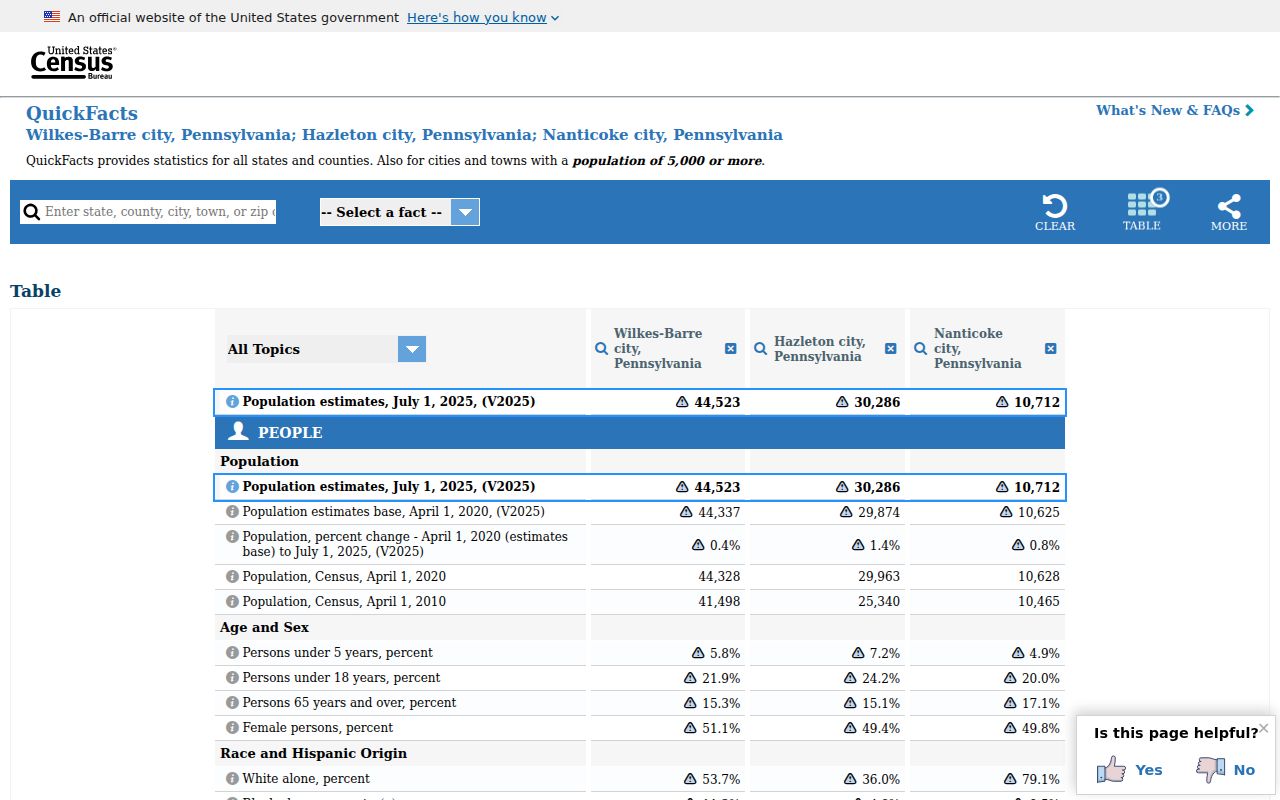
The image supports population context only. It should not be turned into a crime rate because the research did not supply a complete, same-year agency crime table.
For an in-person Common Pleas file, the Water Street Parkade at 5 Water Street offers free public parking and a tunnel to the courthouse’s rear accessible entrance. City police records still begin at North Washington Street. Plan the visit around the record, not just the nearest public building.
Public Access Rules in Wilkes-Barre
Wilkes-Barre Police records are subject to Pennsylvania public-record rules, but public access is not absolute. A written request should identify an existing record with enough detail for the city to locate it. The city may withhold criminal-investigation material and protect victims, juveniles, confidential sources, personal identifiers, medical facts, and security-sensitive information. Ask for any part that can be separated and released.
Court records follow the UJS Public Access Policy and judicial request procedures rather than ordinary city RTKL processing. Use the court portal first, then ask the district office or Clerk for paper or filed documents. Expunged and limited-access cases do not appear in public UJS results, so a missing result can reflect a legal restriction rather than a broken city search.
Key access rules:
Pennsylvania Right-to-Know Law §§703 and 705 require a specific request for an existing record, without requiring a reason.
RTKL §708(b)(16) permits withholding protected criminal-investigation material even when a related arrest or docket is public.
UJS public-access policy and court-record procedures govern judicial case information and confidential court fields.
Preserve the request and any response. A denial should state its basis and appeal route, while a lawful extension can move final production beyond the ordinary initial five-business-day response period.