
Checking Criminal History in Luzerne County
No single search produces every part of a Luzerne County record. Begin with the Unified Judicial System of Pennsylvania Web Portal for free Court of Common Pleas and Magisterial District Court dockets. The state court search shows filed charges, bail, hearings, disposition, sentence, and linked lower-court information when public. Then choose the office or system that holds the missing layer. Police keep incident narratives. Luzerne County Corrections creates booking and custody records. The Clerk of Courts keeps the Common Pleas file. Pennsylvania State Police maintains repository criminal-history data.
The official UJS search screen shows why court type and county matter. It appears below as a neutral interface, not as a private case result.
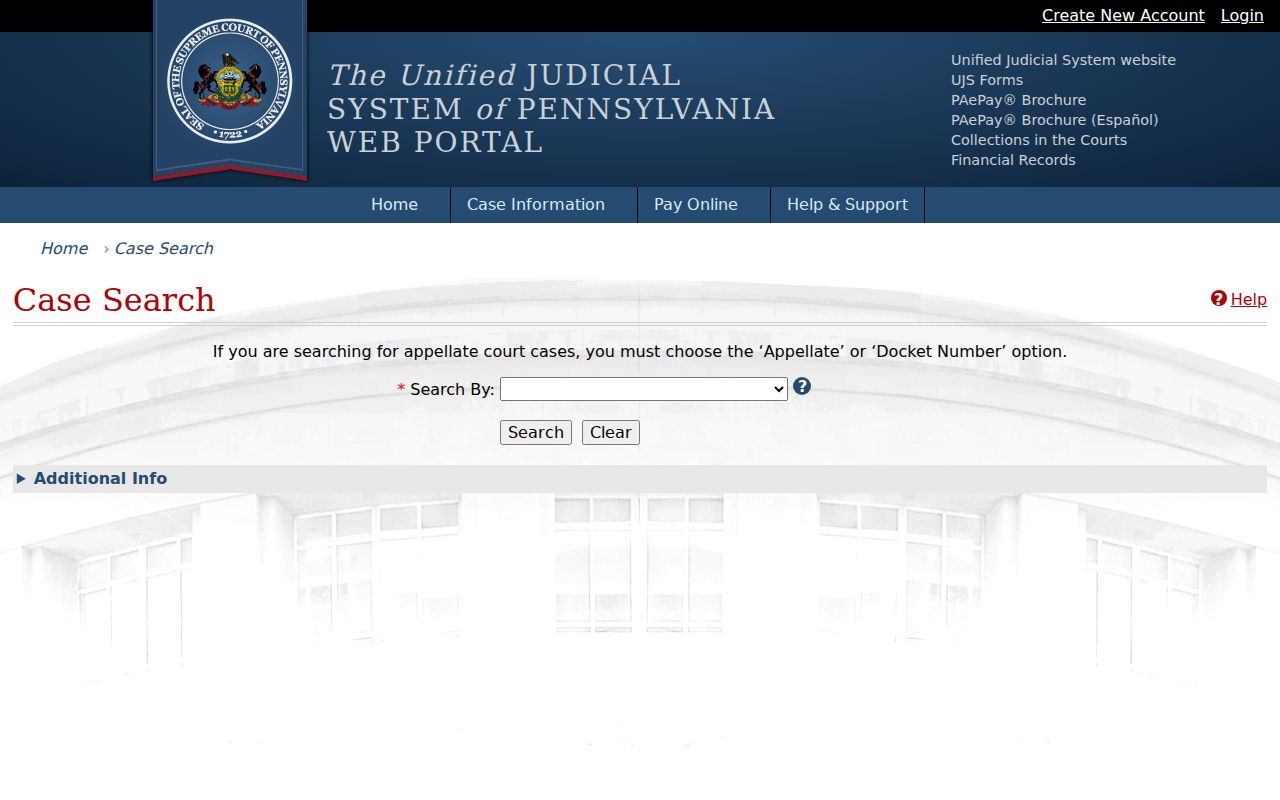
Use the portal first for case status, then request the source document when a docket entry alone does not answer the question.
- Gather the full name, spelling variants, approximate filing date, and any known docket or OTN number.
- Search both Court of Common Pleas and Magisterial District Court records with Luzerne County selected.
- Compare the court, arresting agency, dates, and linked docket identifiers before deciding that a result matches.
- Open the docket and read each charge beside its disposition instead of treating the charge list as the outcome.
- Ask the Clerk, the assigned district court, police, or the state repository for the distinct record still needed.
Five Luzerne County Record Systems
A police report, booking record, court docket, PATCH response, and registry profile are five separate products. A Luzerne County police report explains the call, evidence, and officer action to the extent the agency may release it. Booking data marks intake, prints, charges, bond, and release. A docket records what the court did. PATCH reports information held in the PSP Central Repository. The Megan's Law site publishes only data that Pennsylvania registry law authorizes. None is a substitute for the other four.
Timing also changes what each source can show. Right after an arrest, police or Corrections may know more than the public docket. A district court case can appear before a CP-40-CR Common Pleas docket exists. PSP reporting and identity review can take longer. A dismissal on the docket does not, by itself, remove every arrest or booking trace. The proper question is not which source is best in all cases. It is which office owns the fact being checked.
- OTN
- The tracking number that helps connect an arrest and lower-court case to later Common Pleas records.
- Disposition
- The result for a charge, such as guilty, dismissed, withdrawn, or acquitted.
- Capias
- A court order used to bring a person before the court, often after nonappearance or noncompliance.
- Limited access
- A Pennsylvania restriction that removes eligible case information from general public view without treating every record as destroyed.
Pennsylvania Official Background Checks
The Pennsylvania State Police Bureau of Records and Identification operates Pennsylvania Access To Criminal History, or PATCH. A standard individual name check costs $22. Eligible volunteer requests are free, and notarization adds $5 to an eligible standard request. An ordinary user may submit up to ten names in one session. A “No Record” response may arrive at once, while “Under Review” means PSP must compare the data manually and may take two to four weeks. Save the control number and request date.
The official PATCH entry screen distinguishes a new request from status retrieval. The image is useful for recognizing the correct PSP product.
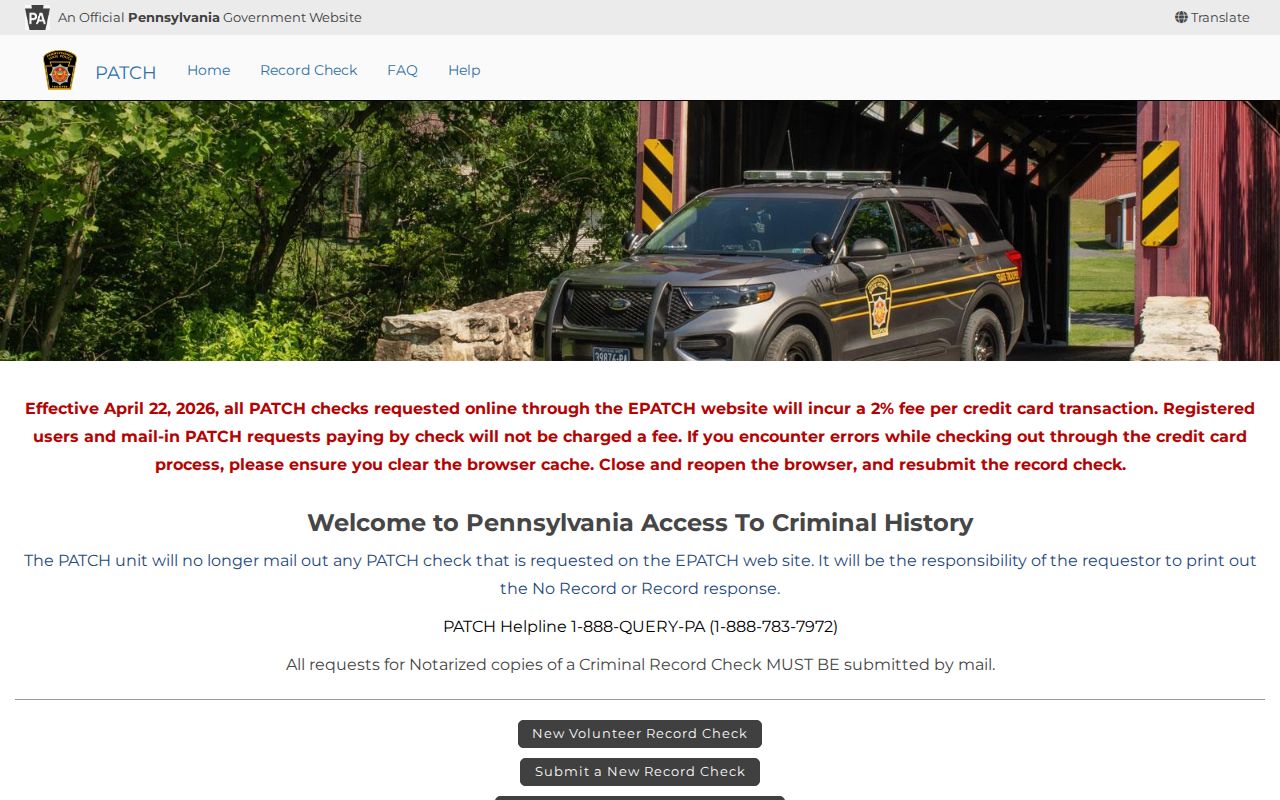
PATCH is a Pennsylvania repository response, not an FBI file or a copy of every Luzerne County court document.
| Official product | Use and access | Published charge |
|---|---|---|
| PATCH standard request | Public name-based Pennsylvania repository check | $22 |
| PATCH volunteer request | Qualified volunteer request; not eligible for notarization | Free |
| PATCH notarization | Add-on for an eligible standard response | $5 |
| SP 4-170 | Mail route to review one's own fuller Pennsylvania record | $20 |
Luzerne County Fingerprint Record Route
Fingerprint checks for legally authorized Pennsylvania programs use IDEMIA/IdentoGO. Registration comes first. The service code controls the program, price, and identity-document list, so there is no one stable Luzerne County walk-in fee or site that applies to every request. After registering, use the official Pennsylvania location finder for the current enrollment sites and hours. An appointment is optional after pre-registration but can cut wait time.
The location finder changes as vendor sites change, which makes the official locator safer than a hard-coded storefront address.
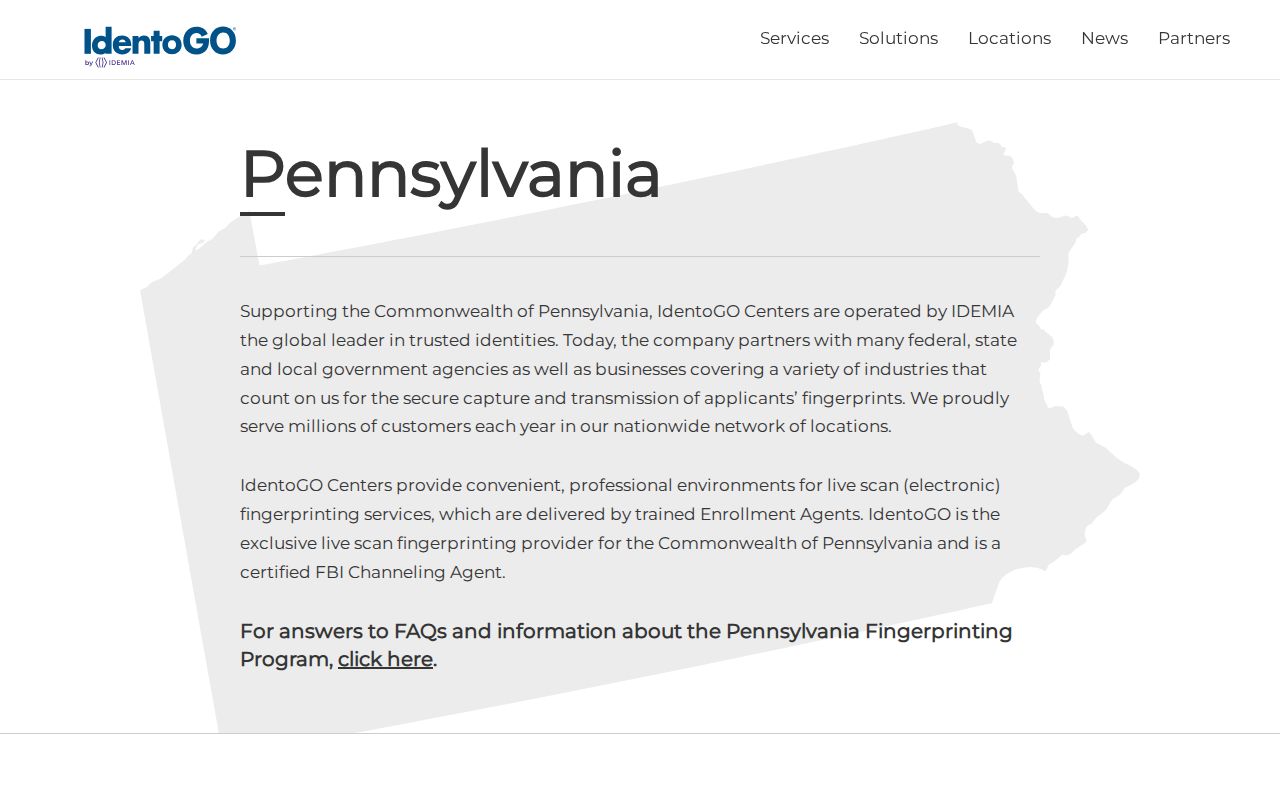
A fingerprint receipt confirms capture, not completion of the requested criminal-history product. FBI Identity History Summary requests are subject-only federal reviews and do not replace Luzerne County dockets.
Criminal Record Types
Luzerne County records divide by event and custodian. The investigating police department keeps the incident and arrest narrative. Corrections keeps intake and present-custody material. A Magisterial District Judge records preliminary arraignment, bail, preliminary hearing, and summary matters. The Clerk of Courts maintains the Common Pleas case after charges are held for court. PSP builds the repository history from qualifying reports. PA DOC tracks state custody and parole, while the PSP registry has a much narrower statutory purpose.
- Police and arrest report: the agency account of the incident, alleged conduct, evidence, and arrest.
- Booking record: intake identity, booking time, photograph, fingerprints, charges, bond, and release data.
- Court file: complaint, charge grades, bail, motions, pleas, trial events, disposition, sentence, and costs.
- Repository response: PSP's name-matched Pennsylvania criminal-history product, with its own scope and identity limits.
- Custody or registry profile: a purpose-specific view of confinement, parole, notification, or registration status.
Luzerne County Custody Record Views
Current local custody begins with Luzerne County Corrections and PA SAVIN. PA SAVIN can send phone, text, email, or app alerts for release, transfer, or escape, but it is a notification service rather than a certified booking record. Call Corrections at 570-829-7741 when a booking is very recent or identity is uncertain. A targeted request can ask for an existing booking sheet or admission and release dates, subject to legal limits.
State confinement and parole belong in the PA DOC Inmate/Parolee Locator. Its official screen is shown below.
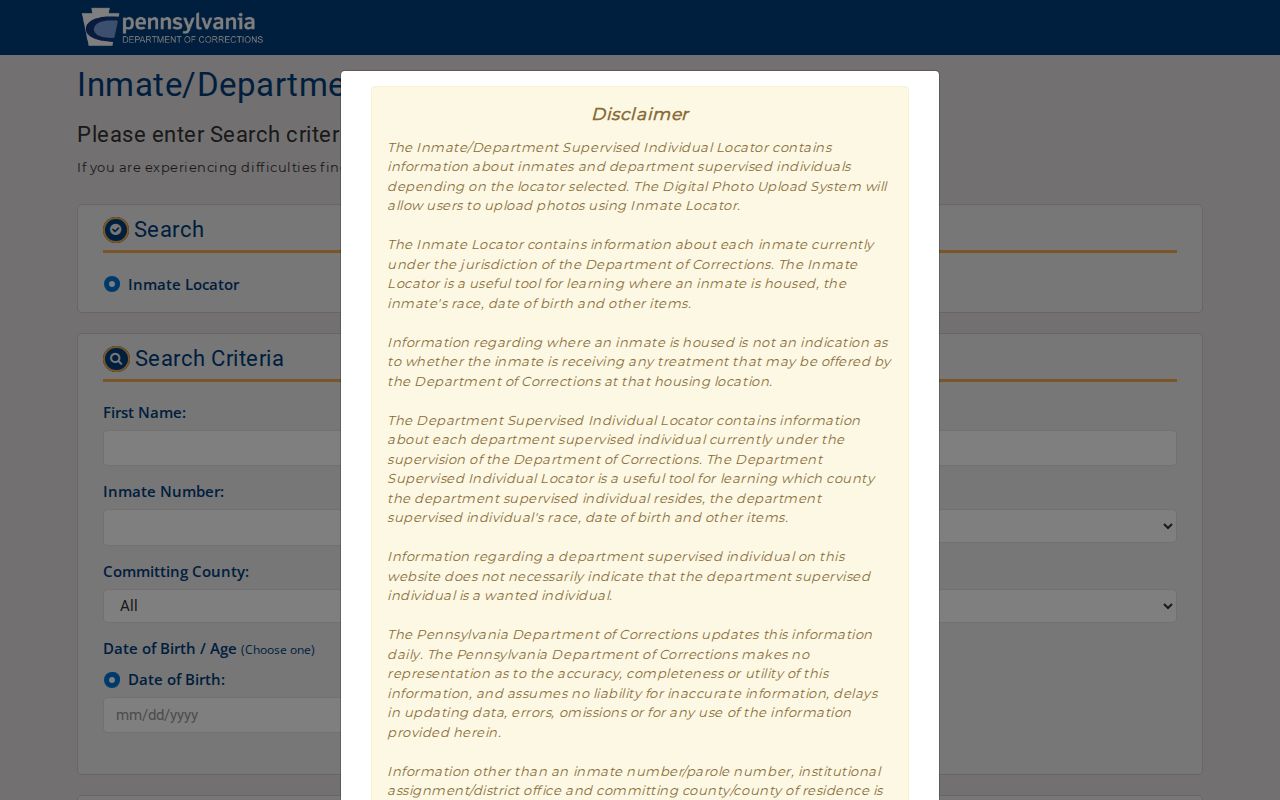
The locator may show an inmate or parole number, institution, sentence range, release, and parole fields. It will not narrate a Luzerne County police incident. Federal imprisonment requires the Federal Bureau of Prisons locator, and a person awaiting a federal case in the county jail may still appear through the local custody route.
Inside a Luzerne County Criminal Record
Read a Luzerne County record by field, not by headline. A public UJS docket can identify the court, docket number, filing date, status, assigned judge, originating district court, OTN, arresting agency, and complaint date. Charge rows list the statute, subsection, description, grade, and disposition. Separate areas can show bail, counsel, scheduled events, filings, sentence parts, and financial obligations. The label “disposed” does not mean that every count ended in conviction.
| Name and identity | Caption and public identifiers used to compare a possible match without exposing restricted data. |
|---|---|
| Origin | MDJ docket, OTN, complaint data, and arresting agency that connect the early case to Common Pleas. |
| Charges | Count, statute, description, grade, and the separate final disposition for each allegation. |
| Bail and events | Bail type, amount, status, hearings, arraignment, plea, trial, or sentencing dates as entered. |
| Outcome | Disposition, sentence components, costs, payments, and appeal information where public. |
| Protected data | Personal identifiers, protected victim details, sealed cases, and confidential documents are suppressed. |
A police narrative contains facts and evidence that PATCH and a docket usually do not reproduce. A full subject-access PSP record can also differ from a public certificate. Compare the same person and incident across products before drawing a conclusion.
Luzerne County Record Check Limits
The Clerk of Courts offers a published $17.75 record check per person, but it is county-only. The county's own record-check explanation makes that boundary important.
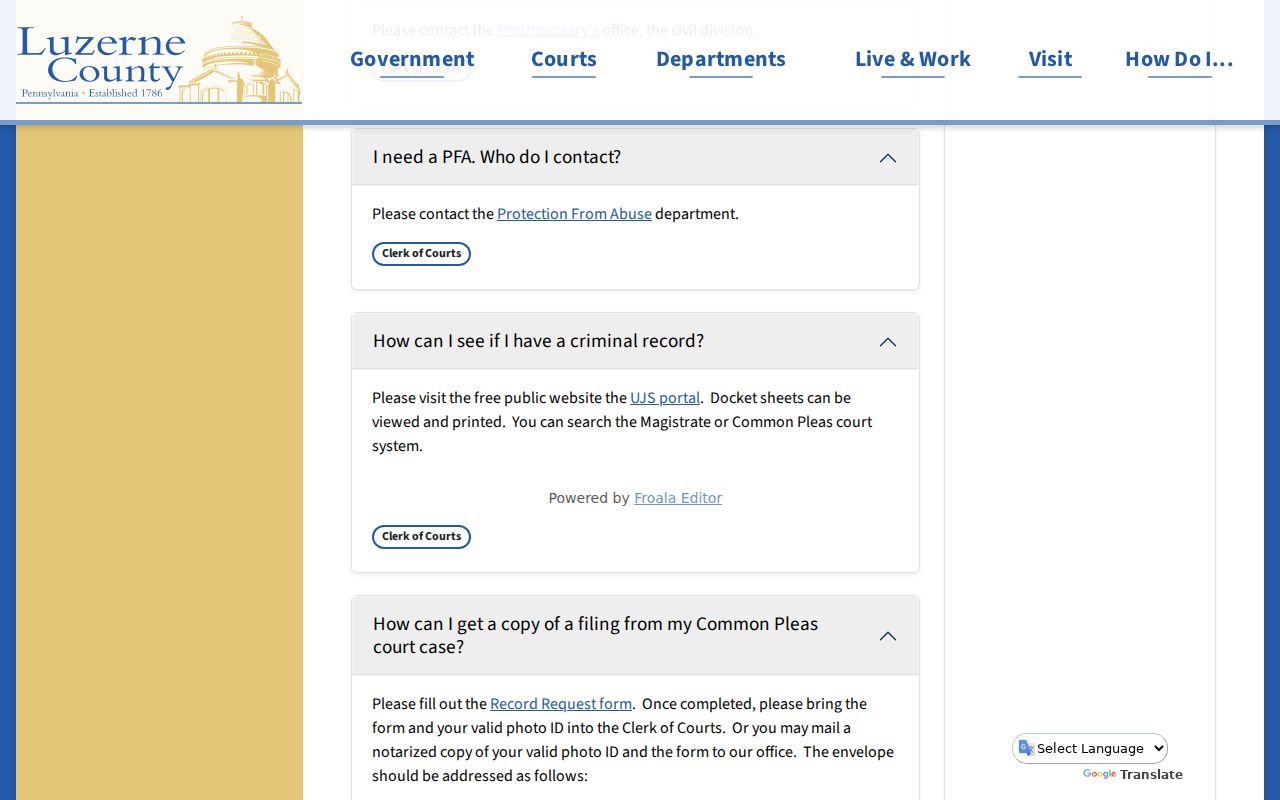
The Clerk check does not become a statewide PATCH response simply because both concern criminal records. Call the warrants and record-check line at 570-825-1855 to confirm the current charge and accepted payment before visiting.
At the courthouse counter, say what is needed: a name check, inspection of one case, an uncertified document, a certified copy, or an expungement filing. “The whole criminal record” can point staff toward the wrong product. Bring a precise spelling, approximate year, and docket or MDJ number when known. The Clerk advertises different payment methods for different transactions, and money is not accepted after 4:00 p.m. even though the office remains open until 4:30 p.m.
Public Access Laws in Pennsylvania
The Pennsylvania Right-to-Know Law governs many agency records, but judicial case files primarily follow the UJS Case Records Public Access Policy. A public arrest or docket does not force an agency to release a full investigative narrative. Witness statements, confidential sources, juvenile information, protected victim data, personal identifiers, and security-sensitive material may be withheld. Ask the Clerk for case documents and the police agency for its own report.
Key Pennsylvania authorities:
RTKL §§703 and 705 require a specific request for an existing record; an office need not create a new one.
RTKL §708(b)(16) protects qualifying criminal-investigation material from disclosure.
18 Pa.C.S. Chapter 91 sets the framework for criminal-history information and dissemination.
UJS Public Access Policy governs public judicial case information and confidential court data.
18 Pa.C.S. §9122.1 supplies Pennsylvania Clean Slate limited-access rules.
Luzerne County Record Request Clock
A written Luzerne County RTKL request should name an existing record and give enough detail to locate it. Include the department, record type, date range, incident or case number, location, and subject matter. State whether inspection, copies, certified copies, or electronic delivery are wanted. Requests may be sent by email, mail, fax, or in person to the proper department's open-records officer. The county does not accept anonymous RTKL requests and may require proof of identity.
The official county directory helps locate the department that owns the record.
Ordinarily, the agency has five business days for its initial response, though a lawful extension may state a reason and later date. Preserve the request and reply for an appeal. DA requests go in writing to its named open-records officer, while judicial denials use court access procedures rather than assuming the Office of Open Records handles every dispute.
Sealed, Expunged, and Restricted Records
Pennsylvania distinguishes expungement from limited access and automatic Clean Slate restrictions. Eligibility turns on the disposition, offense, age, elapsed time, and later history. A dismissal alone does not prove that every police, booking, repository, and court trace vanished. Expunged and limited-access cases do not appear in the public UJS search, so an empty result can reflect access law rather than a statement that no case ever existed.
Luzerne County instructions direct filers to review the case at the Clerk's second-floor counter, prepare the proper petition, and pay a stated $132 filing charge. The statewide forms include Rules 490 and 790 expungement paths and Rule 791 limited-access procedure. Call the Clerk's expungement line at 570-825-1755 to confirm the case category, fee, copies, PSP attachment, and judge-assignment steps. Court staff can explain filing procedure but cannot decide eligibility or give legal advice.
Luzerne County Warrant Record Route
No reliable official public sheriff warrant-name database was located for Luzerne County. An absent web result is not proof that no warrant exists. Start with the UJS docket for case context. Then call the Clerk's warrants and record-check line at 570-825-1855 or the assigned Magisterial District Court to confirm the current status, issuing court, docket number, bond information, and approved resolution process. A changing status makes an RTKL request a poor emergency check.
Court Administration publishes capias hearing periods at the courthouse, but that calendar does not let a person place a case on a session. The assigned court must confirm it. Bench warrants, complaint-based arrest warrants, and search warrants have different functions. Anyone facing immediate arrest risk should obtain current instructions from the responsible court and authorized legal advice before acting.
Luzerne County Criminal Records by City
Wilkes-Barre, Hazleton, and Nanticoke are the county's three largest incorporated cities by 2020 Census count. Their police departments create city incident and arrest reports, but criminal court work moves through assigned Magisterial District Judges and then the Luzerne County Court of Common Pleas when charges are held for court. City records do not sit in one county police file. Use the city guide for the incident channel, then move to county court and custody systems as the case advances.
Wilkes-Barre Criminal Records
44,328 residents in 2020. City police reports, Central Court, and the nearby county courthouse are separate record stops.
Hazleton Criminal Records
29,963 residents in 2020. Police and district-court records connect to the county Clerk's limited-service Hazleton Annex.
Nanticoke Criminal Records
10,628 residents in 2020. Exact incident location determines the city police agency before the case moves into county systems.
Luzerne County Court Record Counters
The main criminal filing counter is the Clerk of Courts at 200 North River Street in Wilkes-Barre. The office is open weekdays from 9:00 a.m. to 4:30 p.m., with no money accepted after 4:00 p.m. Common Pleas files, summary appeals, criminal payments, and record-check routing center there. Sixteen Magisterial District Courts keep their own preliminary and summary paper files. Central Court at 77 Water Street supports early criminal processing, while Court Administration verifies scheduled hearings at 570-825-1596.
The official Clerk of Courts page lists the filing office contacts and explains the Hazleton Annex limits.
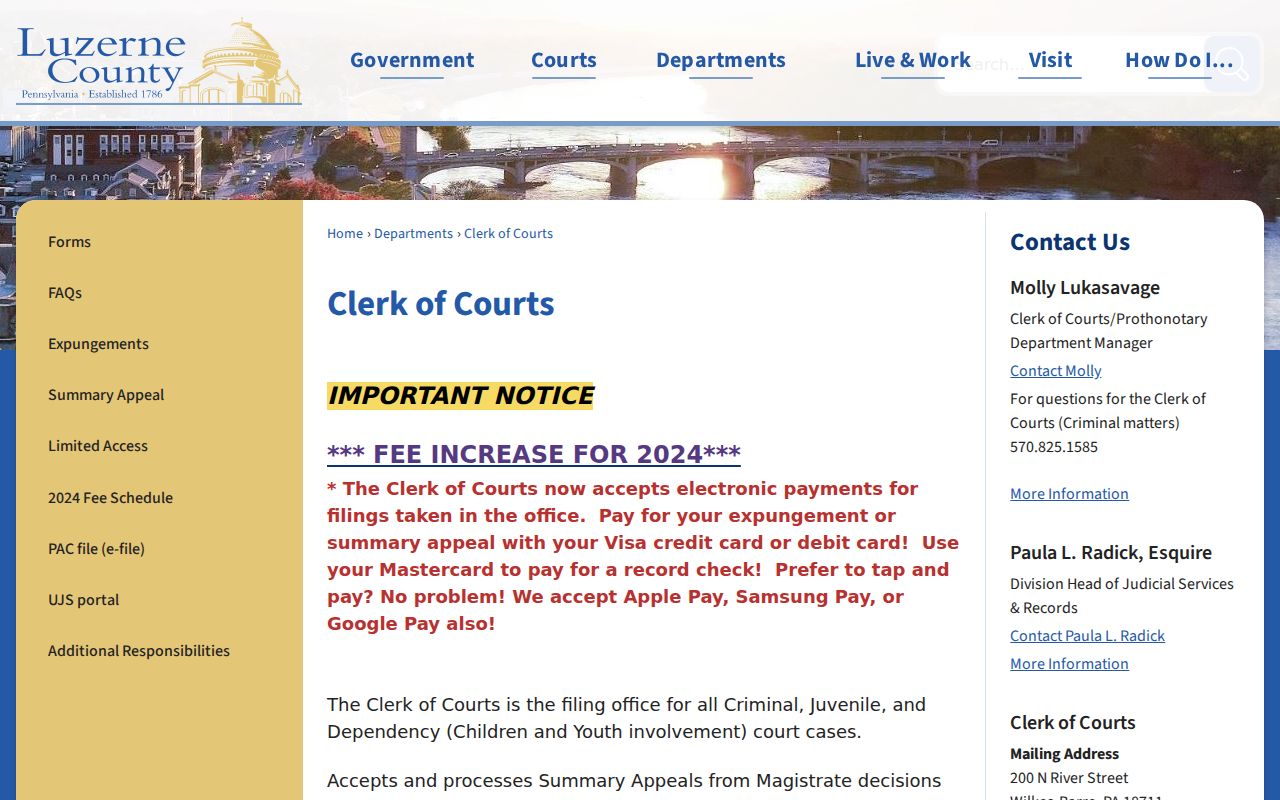
The Annex operates from 10:00 a.m. to 3:00 p.m., takes no cash, and requires filings to be completed while the visitor waits. It offers many Clerk services but excludes some juvenile and dependency work. Bail there requires a cashier's check. Confirm the transaction and payment method before making the trip.
The county also posts its current Clerk fee-schedule landing page for copy and filing charges.
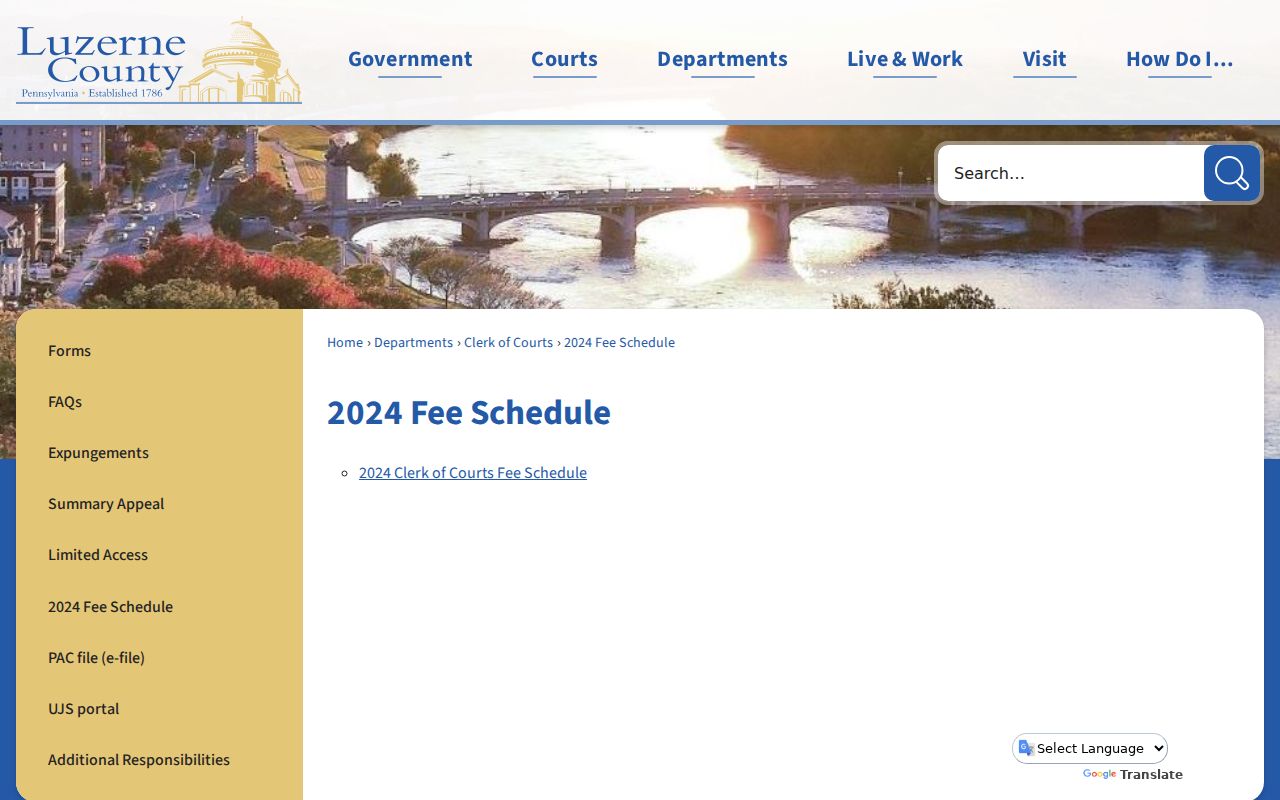
Use the live page and a call to the relevant Clerk line because the linked itemized schedule may carry an older filename while payment practices continue to change.
Luzerne County Registry Record Boundary
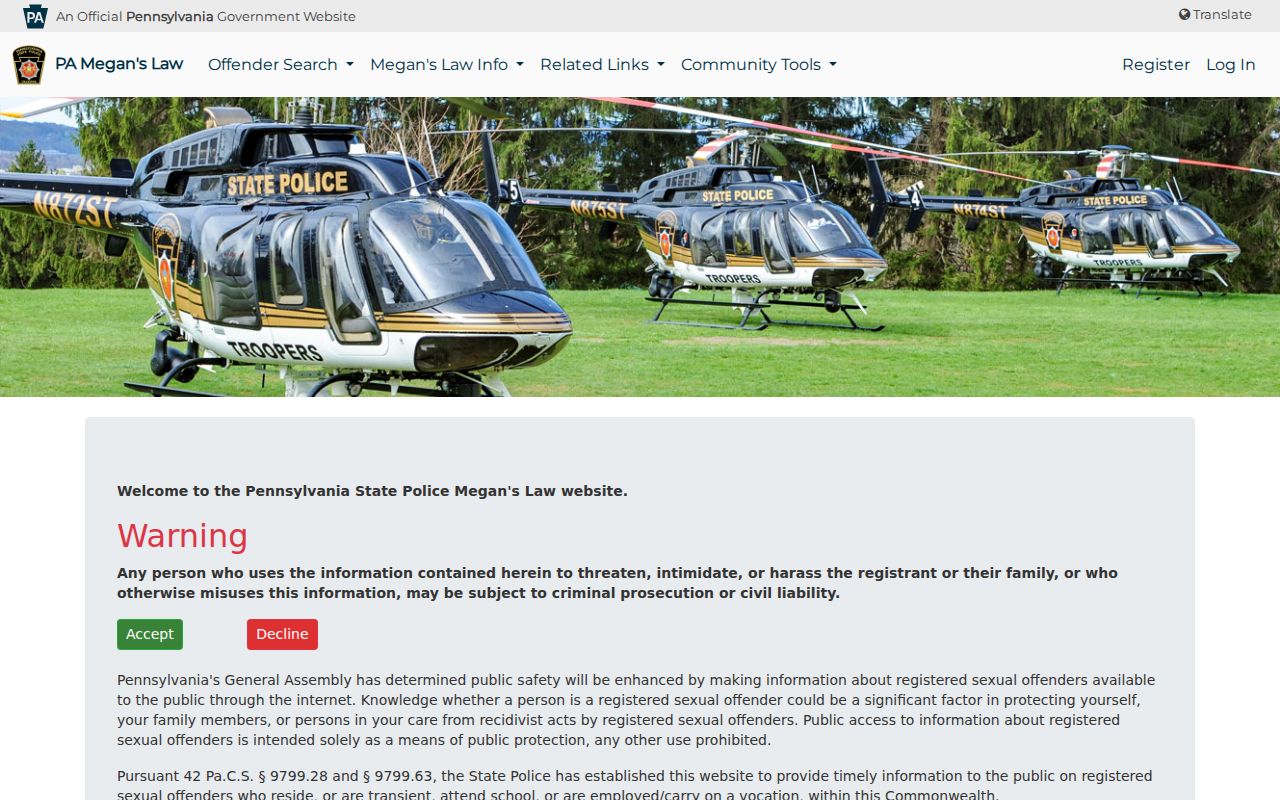
The Pennsylvania State Police Megan's Law Public Website is a public safety notification system, not a list of all criminal cases. Searchers can select Luzerne County and narrow by municipality, name, ZIP, address, or map options offered in the interface. Public profiles may contain identity, physical description, residence, work or school information, vehicle data, registering offense, compliance, classification, and update dates as authorized.
The official county search screen is the right place to start a Luzerne County registry check.
Registry absence does not prove that no sexual-offense case exists, and profile data does not allege current crime. Pennsylvania Megan's Law does not create a statewide residency-distance buffer. Use registry information only for lawful awareness, never to contact, follow, threaten, harass, or build a private dossier about a listed person.